BloombergNEF Lifts Its Ten-Year US Storage Outlook by 30%
Analysts at BloombergNEF have sharply revised upward their projections for US energy storage, lifting the ten-year capacity outlook by 30% within a single half-year review. The revision reflects improving economics for solar-plus-storage projects and a surge in firm commercial commitments tied to data center power demand.
Under the updated forecast, cumulative US storage capacity is set to hit 213.9 GW in 2030, then 434.4 GW six years after that. Globally, deployments are expected to hit 3,098 GW and 11,106 GWh by 2036 — roughly ten times today’s installed base. The rapid buildout is reshaping how much storage accompanies solar worldwide. In 2016 cumulative installed solar outweighed storage by 94 times; a decade later that gap stands at seven to one.
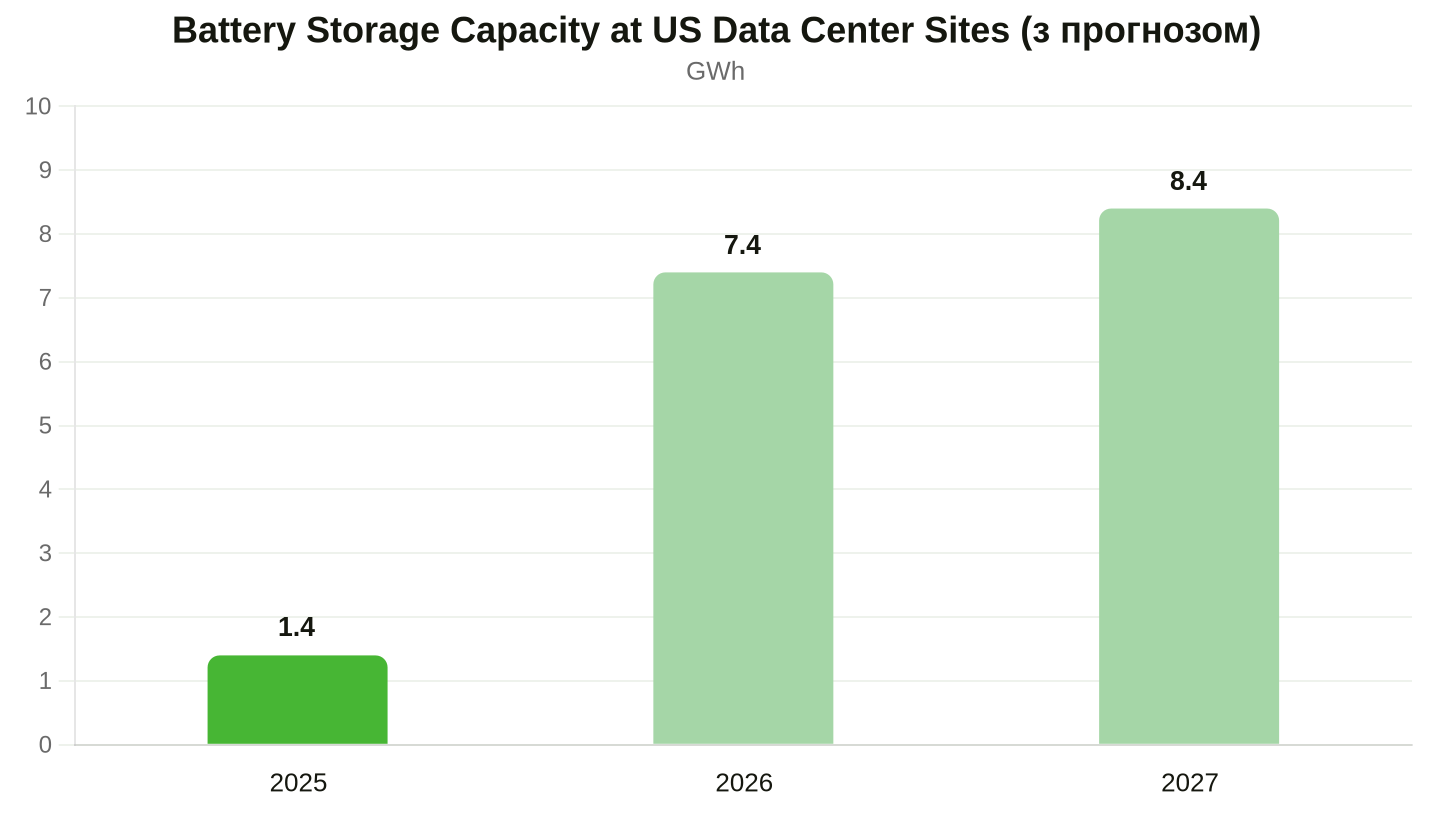
The fastest-growing segment is storage deployed directly at data center sites. From roughly 500 MW and 1.4 GWh in 2025, on-site data center capacity is forecast to reach 4.9 GW and 7.4 GWh this year, climbing further to 8.4 GWh by 2027. Several large contracts are already driving that trajectory: storage systems provider Fluence booked a $300 million order from one data centre operator, while Canadian Solar’s e-Storage division will supply 500 MW and 2.5 GWh to a major US utility supporting grid infrastructure serving data centers.
Growth is continuing despite 40.9% tariffs on Chinese stationary batteries. That pressure is accelerating domestic alternatives: sodium-ion battery maker Peak Energy closed a $108 million funding round with participation from General Motors, targeting nearly 5 GWh of deployed capacity by 2030. BNEF expects sodium-ion penetration to reach 9% by 2036.
Source: Utility Dive
Become a member of 100 RE UA
Switching to 100% renewable energy in Ukraine is possible!