
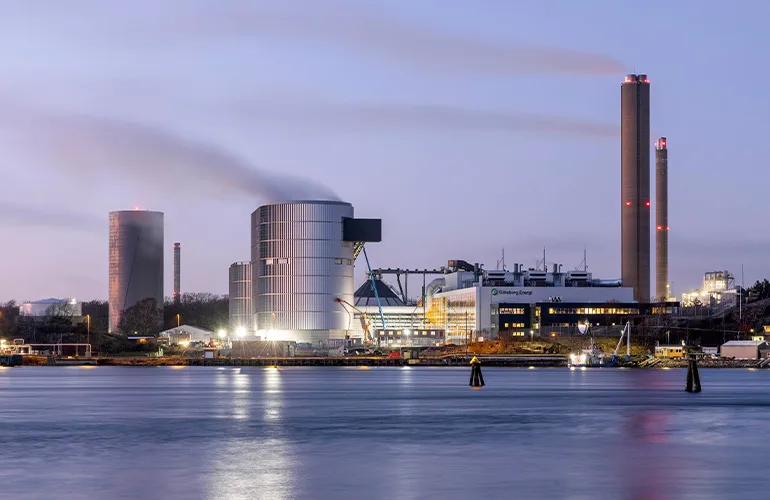
Biomass Boiler Replacing Fossil Gas: How Gothenburg Is Moving to 100% Renewable District Heating
n December 2025, the municipal energy company Göteborg Energi AB began commissioning a new biomass-fired steam boiler at the Rya CHP plant, a key hub in Gothenburg’s district heating system.
The project marks a decisive step away from fossil natural gas, significantly reducing carbon emissions while strengthening the city’s long-term energy security.
Key Project Parameters
The new biomass unit delivers 156 MW of thermal capacity and 39 MW of electrical output, covering a substantial share of Gothenburg’s district heating demand.
Fuel is sourced from locally available processed wood and forestry residues, reinforcing a circular, regionally anchored energy model.
According to the company, replacing fossil gas with biomass will cut fossil CO₂ emissions by approximately 30,000–150,000 tonnes per year, depending on operating conditions. With a total investment of around EUR 231 million, the project represents Göteborg Energi’s largest single climate-related investment to date.
Proven Technology and Fuel Flexibility
The boiler is based on bubbling fluidised bed (BFB) technology, which enables efficient combustion of a wide range of biomass fuels with varying moisture content and particle size.
This flexibility enhances operational reliability and allows the plant to adapt to changing fuel availability without compromising performance.
100% Renewable Heat for the City
By integrating the new biomass boiler into the existing Rya CHP infrastructure, Göteborg Energi can—under normal operating conditions—supply 100% renewable and recovered energy to Gothenburg’s district heating network.
Company leadership emphasises that the transition not only cuts emissions but also reduces exposure to volatile fossil gas markets, improving both climate performance and supply security.
Economic Stability and Predictable Heat Prices
Moving away from fossil gas for residential and commercial heating also helps stabilise district heating prices. Biomass-based generation reduces sensitivity to international gas price fluctuations, providing customers with more predictable and resilient heat costs over the long term.
A Pillar of Energy System Resilience
Although fossil gas is no longer used as a primary fuel for heat production, the existing gas turbines at the Rya site remain in place. They can be rapidly deployed to generate electricity during periods of power system stress or shortages.
This dual approach—deep decarbonisation combined with retained backup capacity—positions the Rya CHP plant as a strategic asset for Gothenburg’s energy security.
Why This Case Matters
The Gothenburg project demonstrates how large cities can replace fossil gas in district heating with biomass at scale, without sacrificing reliability or affordability.
It offers a concrete, bankable example for municipalities across Europe and beyond that are seeking to decarbonise heat supply while reinforcing energy independence and system resilience.
Become a member of 100 RE UA
Switching to 100% renewable energy in Ukraine is possible!