
Nizhyn Discusses Energy Solutions for the Water Utility and Municipal Dental Clinic under ANEW-LIFE
A webinar dedicated to the discussion of priority energy interventions for the Nizhyn community was held within the framework of the ANEW-LIFE project. The event brought together representatives of the Executive Committee of Nizhyn City Council, municipal enterprises, financial institutions, Ukrainian and European project partners.
The event was part of the work on preparing feasibility studies for the selected energy projects. Its purpose was to discuss in more detail the technical aspects of implementing the solutions, equipment requirements, possible financing mechanisms, legal and organisational issues, as well as to receive feedback from community representatives and facility owners.
The ANEW-LIFE project aims to support Ukrainian cities in their transition towards a sustainable, secure and decarbonised energy system. Its focus is not only on technical solutions, but also on finding innovative financing mechanisms that can help municipalities implement energy efficiency projects under conditions of limited resources. Within the project, more than 20 consultations with municipalities have already been held, around 30 potential energy projects have been identified, and six priority interventions have been selected — two for each pilot city.
For Nizhyn, these interventions are the installation of a solar power plant with an energy storage system for the water utility and the installation of a solar power plant and heat pump for the Nizhyn Municipal Dental Clinic. Both projects are important for the community, as they concern facilities that provide essential services to residents and need stronger energy autonomy.

Nizhyn: a medium-sized city with typical challenges for Ukrainian communities
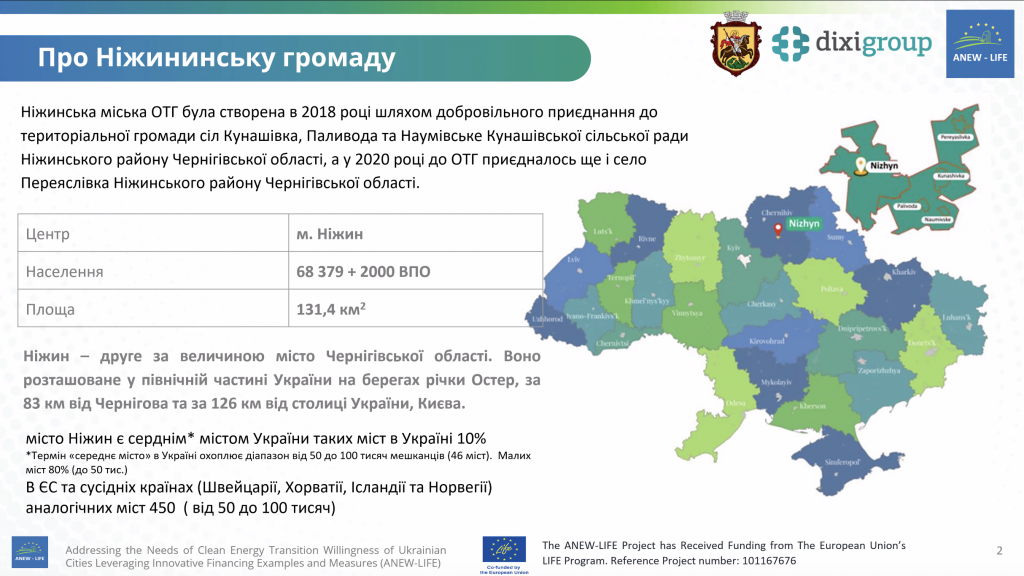
During the presentation, representatives of Nizhyn City Council emphasised that Nizhyn is the second largest community in Chernihiv region by population. The community has around 68,000 residents and includes four settlements. Nizhyn has a convenient logistical location in the centre of Chernihiv region and belongs to the category of medium-sized cities.
It was also noted that cities such as Nizhyn face many common challenges shared by dozens of other Ukrainian municipalities of a similar scale. That is why the solutions developed within ANEW-LIFE may have potential for scaling not only within Chernihiv region, but also among other communities across Ukraine.
The Nizhyn community has already developed a local energy plan, which helps the city systematically assess its energy needs and define areas for modernisation. According to city representatives, a significant share of the energy resources consumed by the community is centralised and produced outside its territory. This creates a high level of energy dependence and increases the need to develop local renewable energy sources.
Among the community’s key challenges are outdated infrastructure, energy losses, the need to modernise municipal facilities, and the need to ensure uninterrupted operation of critical services under wartime risks.
Solar power plant and energy storage system for the water utility
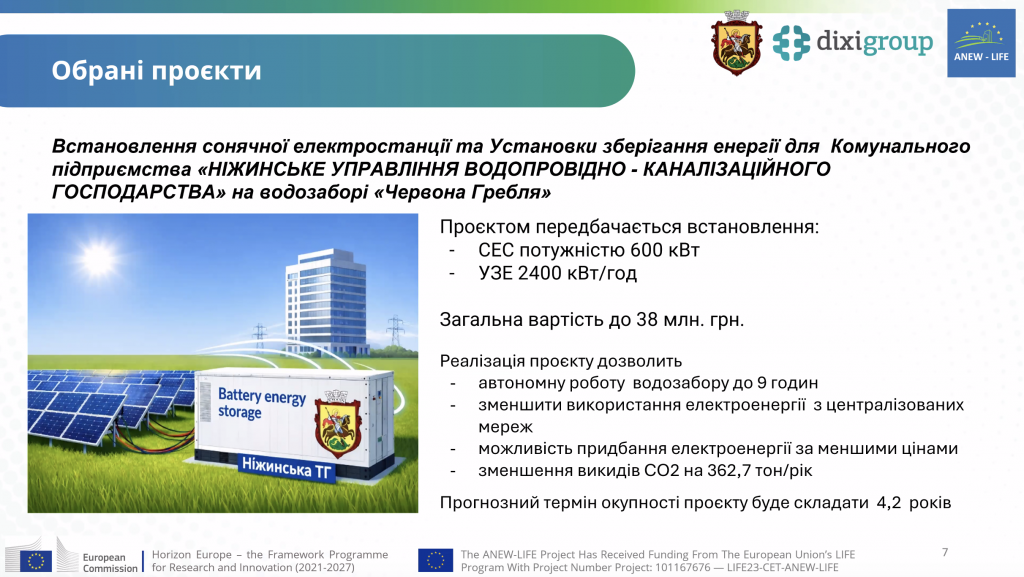
The first priority project in Nizhyn concerns the water utility. The aim of the project is to enable autonomous operation of the facility during power outages and increase the resilience of the water supply system for community residents.
During the webinar, city representatives stressed that water supply is one of the key responsibilities of the local authorities. In the context of the war and attacks on energy infrastructure, ensuring the stable operation of the water utility becomes not only a matter of comfort, but also of community safety.
The proposed project includes the installation of a solar power plant with a capacity of around 60 kW and an energy storage system with an estimated capacity of 2.4 MWh. This configuration should allow the water utility to operate autonomously for up to 9 hours, and in some situations even longer, depending on the consumption mode and operating conditions.
Representatives of the water utility emphasised that generators currently used as backup power sources have limitations. They consume a significant amount of fuel, require scheduled maintenance and cannot operate continuously for long periods. By contrast, solar generation combined with energy storage can become a more resilient solution, especially in situations where fuel supply may be disrupted during crises.
It was also noted that Nizhyn experienced encirclement at the beginning of the full-scale war. This became an important lesson for the community: critical infrastructure must rely on local energy resources that do not require delivery, transportation or complex logistics. Solar energy — and, in the future, other local renewable sources — can become a basis for strengthening the community’s energy autonomy.
Energy autonomy for the Municipal Dental Clinic
The second priority project concerns the Nizhyn Municipal Dental Clinic. This is a separate municipal enterprise that performs an important social function for the community, including providing services to privileged and vulnerable groups of residents.
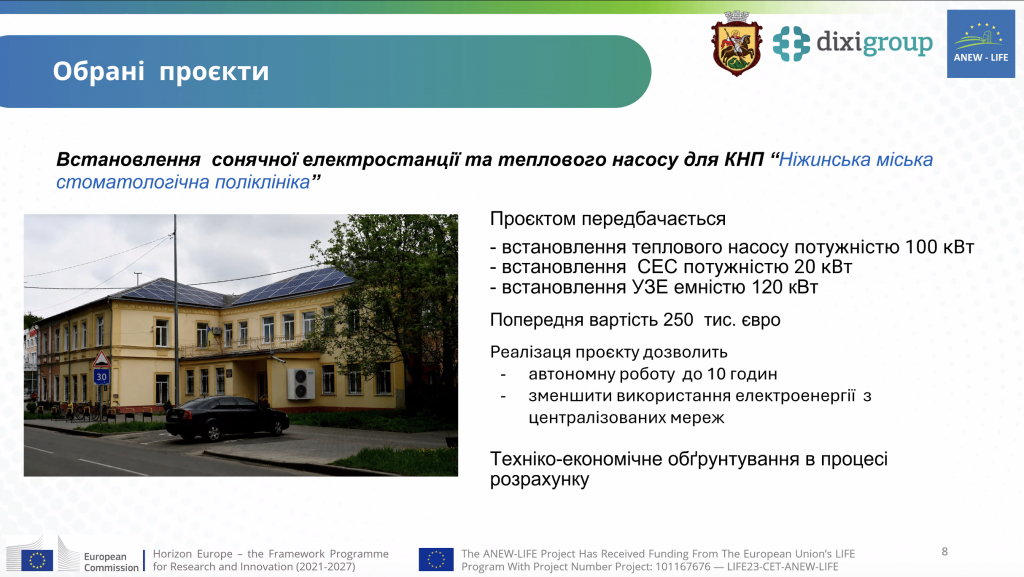
The project provides for the installation of a solar power plant and a heat pump. This combination should help the facility reduce its dependence on centralised energy systems, lower electricity and heating costs, and provide more flexible temperature management in the building.
During the discussion, representatives of the clinic emphasised that the facility’s main operating hours are during the daytime. That is why solar panels can be particularly effective in covering part of the clinic’s own electricity consumption. This is important because the operation of dental equipment directly depends on a stable electricity supply.
The heat pump, in turn, can provide heat for the building, especially during the inter-heating season, when maintaining a comfortable indoor temperature can be challenging. It can also help optimise costs during the heating season. Representatives of the facility noted that, as a separate enterprise, the clinic could achieve additional savings by adjusting the temperature according to its operating schedule: lowering it at night, when the facility is closed, and raising it during working hours.
The estimated cost of this project is around EUR 250,000. For the community, it also has pilot value, as Nizhyn does not yet have sufficient experience in implementing heat pump projects. If successfully implemented, this solution could become an example for other public or municipal buildings.
Financing mechanisms: loans, ESCO, grants and PPA
An important part of the webinar was the discussion of financing mechanisms that could be used to implement the selected projects. For the Nizhyn community, this topic is especially relevant, as the local energy plan estimates the need for financing energy efficiency projects at more than EUR 176 million. Clearly, such an amount cannot be covered solely by the municipal budget.
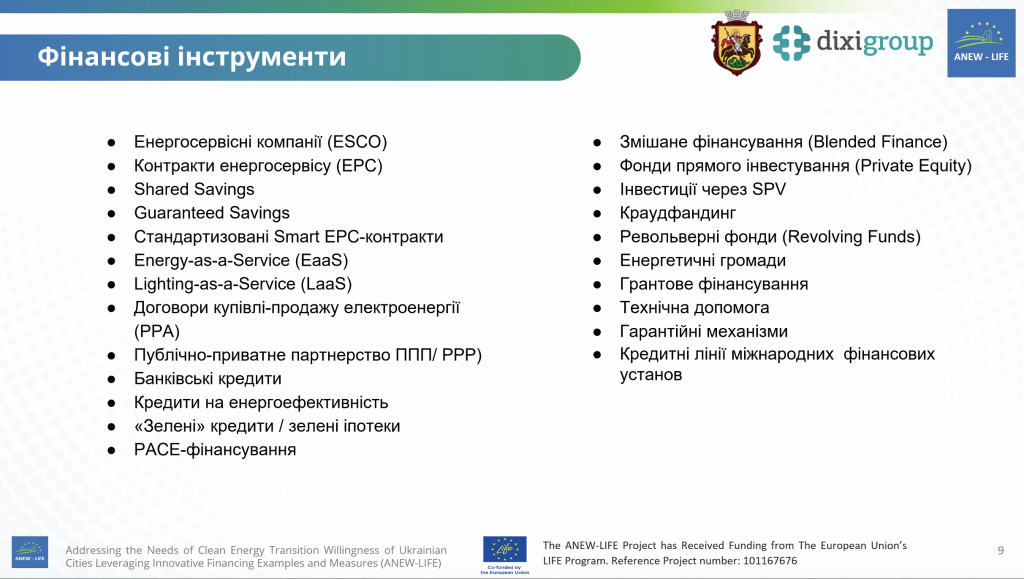
Among the potential mechanisms discussed during the webinar were energy efficiency loans, the ESCO mechanism, grant co-financing and blended finance. The community is also interested in further studying PPA mechanisms — power purchase agreements — and public-private partnerships. City representatives noted that these instruments do not yet fully operate in Ukrainian municipalities, but may have significant potential if properly adapted to the local context.
Nizhyn already has experience working with various sources of financing. The community has used grants, energy efficiency loans, international technical assistance and the ESCO mechanism. In particular, it was noted that Nizhyn became one of the first cities in Chernihiv region to work with energy service contracts. The community has signed 19 ESCO contracts, 11 of which are currently active, with the total value of the contracts exceeding UAH 55 million. These projects have resulted in resource savings and budget savings without the use of municipal funds for implementation.
Representatives of Oschadbank also joined the discussion and presented lending opportunities for legal entities and municipal enterprises. Participants discussed the availability of loans, programme conditions, financing terms, the possibility of early repayment and the role of borrowed funds in implementing energy efficiency projects.
Why these projects matter for the community
Both selected interventions have not only technical, but also social significance. The water utility project is directly linked to the uninterrupted supply of drinking water to residents. Under wartime conditions, when energy infrastructure remains vulnerable, even several hours of autonomous water utility operation can be critical.
The project for the dental clinic concerns the accessibility of healthcare services. The facility works with different categories of residents, including those who need community support. Therefore, stable electricity supply, optimised heating and reduced costs can strengthen not only the financial sustainability of the enterprise, but also the continuity of socially important services.
In addition, both projects have demonstration potential. They can show how a medium-sized Ukrainian city can move from individual energy efficiency measures to systematic planning for the energy autonomy of critical and social infrastructure.
Next steps
Following the webinar, the ANEW-LIFE team will continue working on feasibility studies for the two selected projects of the Nizhyn community. Further work will include clarifying technical parameters, calculating economic feasibility, analysing energy consumption profiles, assessing financing models and preparing implementation recommendations.
For the water utility, it will be important to determine the optimal configuration of the solar power plant and energy storage system to ensure the required level of autonomy. For the dental clinic, the next step will be to detail the parameters of the solar power plant and heat pump, as well as to assess potential savings and payback periods.
Participation in ANEW-LIFE gives Nizhyn an opportunity not only to prepare specific projects for fundraising, but also to develop practical experience that may be useful for other Ukrainian municipalities — especially cities of a similar scale that have limited budgets, outdated infrastructure and an urgent need for quick and realistic solutions to strengthen energy resilience.
In this context, Nizhyn demonstrates an important approach: combining local energy planning, experience with different financing instruments and readiness to test new technological solutions. These are the kinds of approaches that can become a foundation for the sustainable energy transformation of Ukrainian communities.
Become a member of 100 RE UA
Switching to 100% renewable energy in Ukraine is possible!