
Kalush Discusses Energy Projects to Modernise Heat Supply and Strengthen the Resilience of Water Intake Facilities
A webinar dedicated to the discussion of priority energy interventions for the Kalush community was held within the framework of the ANEW-LIFE project. The event brought together representatives of Kalush City Council, municipal enterprises, Ukrainian and European project partners for a professional discussion on the technical, financial, legal and organisational aspects of implementing future solutions.
The ANEW-LIFE project is implemented with the support of the European Union’s LIFE Programme and aims to support Ukrainian cities in their transition towards a sustainable, secure and decarbonised energy system. The project focuses not only on identifying technical solutions, but also on finding realistic financing mechanisms that can help municipalities implement energy efficiency projects even under today’s challenging conditions. The pilot cities of the project are Zhytomyr, Kalush and Nizhyn, while the international consortium of partners works on the technical, financial, communication and strategic components of the energy transition.
During the webinar, the Kalush community presented two priority areas selected for further development within the project: the installation of solid-fuel boiler houses for heating public buildings and the installation of energy storage systems at water intake pumping stations. Both interventions are directly linked to the community’s key challenges: the need to modernise heat supply, reduce dependence on fossil fuels, strengthen the energy resilience of critical infrastructure and identify financially viable implementation models.
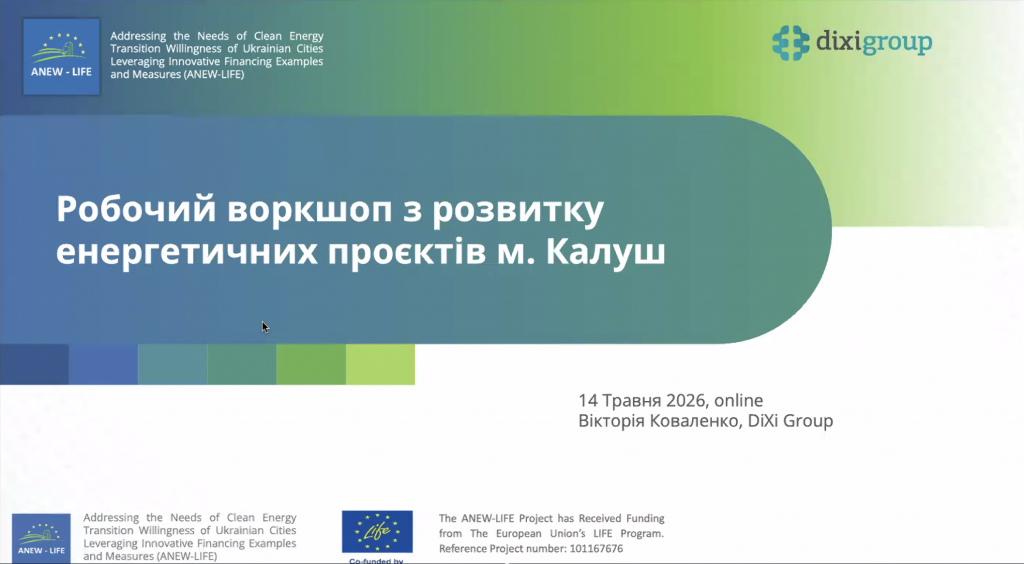
Kalush: an industrial community facing significant energy challenges
The Kalush community is one of the industrial centres of Ivano-Frankivsk region. During the presentation, community representatives emphasised that Kalush generates a significant share of the region’s industrial output, has a large industrial zone and a developed economic base. At the same time, this structure creates a high level of energy consumption and a need for systemic solutions to improve energy efficiency.
One of the most critical challenges for the community is the condition of the heat supply system. According to Kalush representatives, the city’s district heating system has faced deep inefficiency, significant losses and the need for some consumers to switch to autonomous solutions. This is especially relevant for public buildings such as schools, administrative facilities, sports and social infrastructure, which must maintain stable operation regardless of crisis factors.
During the webinar, it was emphasised that for Kalush, energy projects are not only about savings. They are also about community resilience, rational use of resources and environmental impact. City representatives noted that the existing system has significant losses, making heat supply modernisation one of the most important tasks for the community.
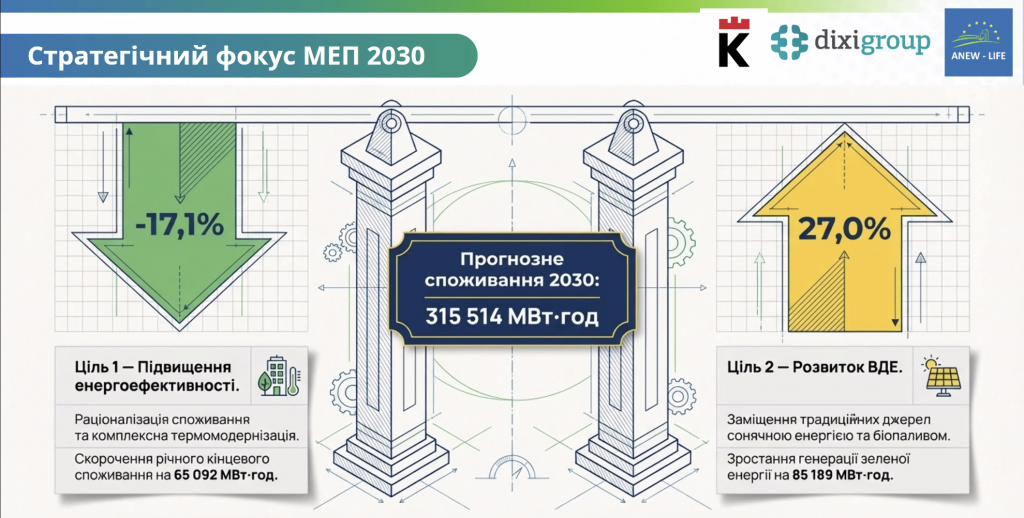
Solid-fuel boiler houses for public buildings
The first priority project presented during the webinar involves the installation of solid-fuel boiler houses for heating public buildings in Kalush. Project design and cost-estimate documentation has already been developed for three such facilities.
The planned boiler houses are intended to provide heat to educational institutions, a sports complex, a concert hall, a school and administrative buildings. In particular, facilities on Lytvyna, Tykhoho and Khimikiv streets are being considered. Each location provides for the installation of boilers with the appropriate capacity, which would allow groups of public buildings to receive autonomous and more efficient heat supply.
The estimated cost of the project is around EUR 1.8 million. However, during the discussion, it was noted that this amount may change depending on logistics, price fluctuations, exchange rates and other factors affecting infrastructure projects during wartime.
For the community, this area is extremely important because it can reduce dependence on an inefficient centralised system, ensure stable heat supply for socially important facilities and decrease energy losses. At the same time, the key issue remains the identification of a financing model that would make it possible to implement the project without placing an excessive burden on the local budget.
Among the potential financing mechanisms discussed during the webinar were public-private partnership, grant financing, co-financing, crowdfunding and the “heat as a service” model, which may be close in logic to an energy service approach, but applied specifically to heat supply.
Energy storage systems for water intake facilities
The second priority project of the Kalush community concerns the installation of energy storage systems at water intake pumping stations. This area is linked to the need to ensure continuity of water supply amid recurring risks to energy infrastructure.
The community has already installed solar power plants at two water intake pumping stations, each with a capacity of around 90 kW. However, solar power plants alone are not enough to guarantee uninterrupted operation, as generation depends on weather conditions and time of day. This is why the community is considering supplementing these facilities with energy storage systems.
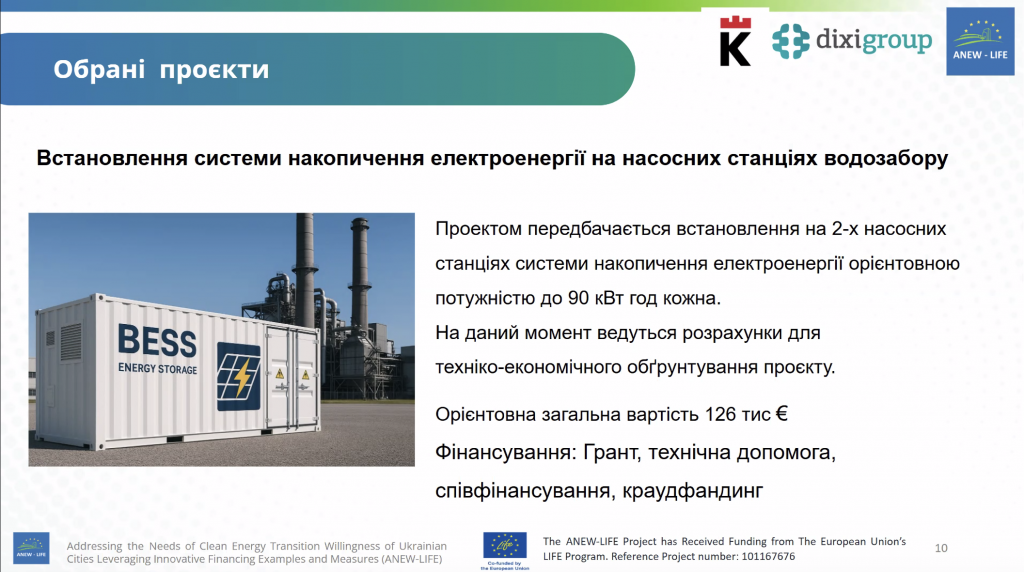
During the webinar, it was stressed that for water supply, it is critically important to prevent prolonged outages, especially in winter. A lack of electricity can create risks not only for residents’ comfort, but also for the physical integrity of water supply infrastructure. The project therefore provides for the installation of energy storage systems at each water intake facility, with an estimated capacity of up to 90 kW each. The preliminary cost of the project is estimated at up to EUR 126,000, while potential sources of financing include grants, co-financing, international technical assistance and crowdfunding.
At the same time, this project has an important technical and legal feature: the solar power plants at the pumping stations were installed under energy service contracts. Therefore, the next stage of work should include a careful assessment of the interaction model between the existing solar power plants, future energy storage systems, grid consumption and electricity metering systems.
Community representatives emphasised the need to find a technical and legal formula that would avoid double-counting electricity and correctly distinguish between energy supplied by the solar power plants under the energy service contract, energy from the grid and energy supplied by the storage systems.
Financing mechanisms and the ESCO question
One of the central topics of the discussion was the possibility of using different financing mechanisms to implement Kalush’s energy projects. During the webinar, community representatives specifically raised the question of whether the boiler houses could be built under an ESCO mechanism or a similar model.
This issue is particularly important for municipalities that have significant infrastructure needs but limited budget resources. In such conditions, the financing model must not only provide access to funds, but also be clear, legally sound, economically justified and acceptable for the community in the long term.
The ANEW-LIFE project is designed precisely to help cities not only develop technical concepts, but also test possible financial instruments. For Kalush, this means an opportunity to assess several scenarios: grant financing, blended finance, public-private partnership, energy service or service-based models, as well as other instruments that can be adapted to the Ukrainian municipal context.
Next steps
Following the webinar, the project team will continue working on feasibility studies for the selected interventions. For Kalush, this means further clarification of the technical parameters of the solid-fuel boiler houses, analysis of the feasibility of energy storage systems for water intake facilities, assessment of costs, risks and potential funding sources.
An important stage will also be the analysis of legal and organisational aspects — especially regarding the combination of existing energy service contracts with new energy storage solutions, as well as the potential use of service-based models in the heat supply sector.
For the Kalush community, participation in ANEW-LIFE is an opportunity to approach several strategic tasks in a systematic way: modernising heat supply, improving the reliability of water supply, reducing energy losses and identifying financing mechanisms for projects that have long-term importance for the community.
If successfully prepared and implemented, these solutions could become examples for other Ukrainian cities facing similar challenges: worn-out heat infrastructure, the need for autonomous energy sources and the necessity to ensure uninterrupted operation of critical facilities under difficult conditions.
Become a member of 100 RE UA
Switching to 100% renewable energy in Ukraine is possible!