Germany’s October EV Surge Leaves Petrol and Diesel Behind
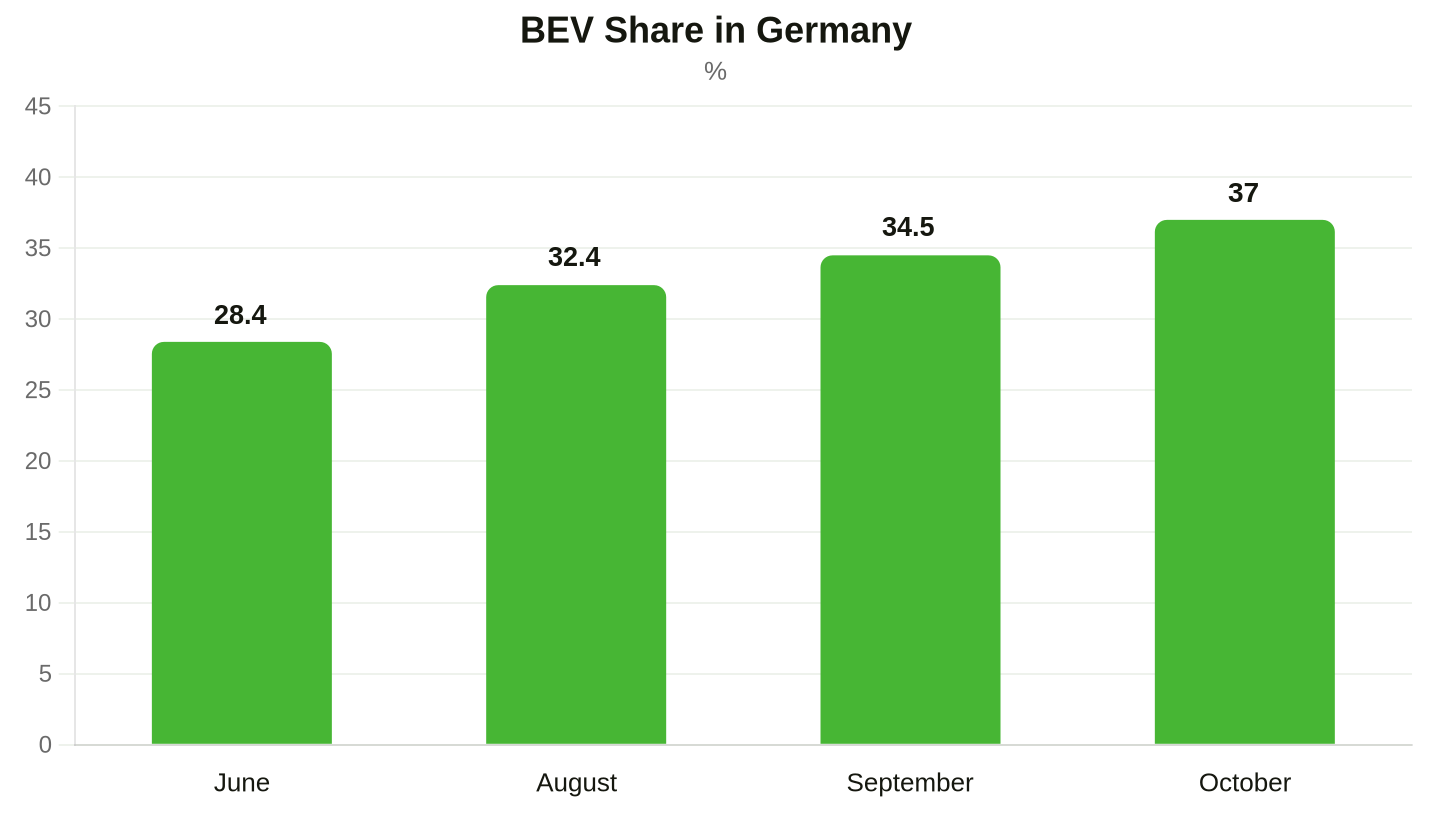
Germany registered 94,086 battery-electric vehicles in October 2026, a 79.5 percent jump from the same month a year earlier that pushed BEVs to 37 percent of an overall car market that itself grew just 1.7 percent. For the second straight month, petrol and diesel combined fell below the BEV share alone.
The shift is stark. Petrol registrations dropped 40.5 percent to 38,516 units, cutting their market share to 15.1 percent. Diesel fell 21.6 percent to 23,882 units, holding only 9.4 percent. Add plug-in hybrids — 28,499 cars, or 11.2 percent — and plug-in models together accounted for roughly half of all new registrations. Fleet average CO₂ emissions declined 21.1 percent to 79.4 g/km.
Germany’s ten-month BEV tally stands at 698,230 registrations, up 60.7 percent, out of 2,476,290 total vehicles — a 28.2 percent share that has already surpassed the VDA industry association’s full-year forecast of 693,000. If October’s pace holds, annual registrations could approach 875,000.
State subsidies are part of the story: a base incentive of €3,000 — extendable to €6,000 for lower-income families with children — helped lift private purchases by 20.6 percent to 40.7 percent of the market. Yet the gains are not flowing evenly to domestic brands. Volkswagen Group reported a €5.9 billion loss and plans to cut 100,000 jobs; Mercedes lowered its margin guidance to 2–3 percent. Meanwhile Chinese entrants are accelerating — Leapmotor registrations surged 288.6 percent to 3,661 units, Xpeng climbed 284.4 percent and MG rose 48.5 percent. BYD edged Tesla 47,961 to 47,742, though the majority of BYD’s figure comprises plug-in hybrids rather than pure electrics.
Source: Electrek
Become a member of 100 RE UA
Switching to 100% renewable energy in Ukraine is possible!