Industrial Demand Flexibility Could Save EU Power System €300 Billion a Year, Report Finds
Europe’s heavy industries are sitting on an underused flexibility resource that could reshape the continent’s electricity system — but sector economics vary widely, according to a Solar Promotion report drawing on smartEn research covering steel, aluminium, paper, glass and cement.
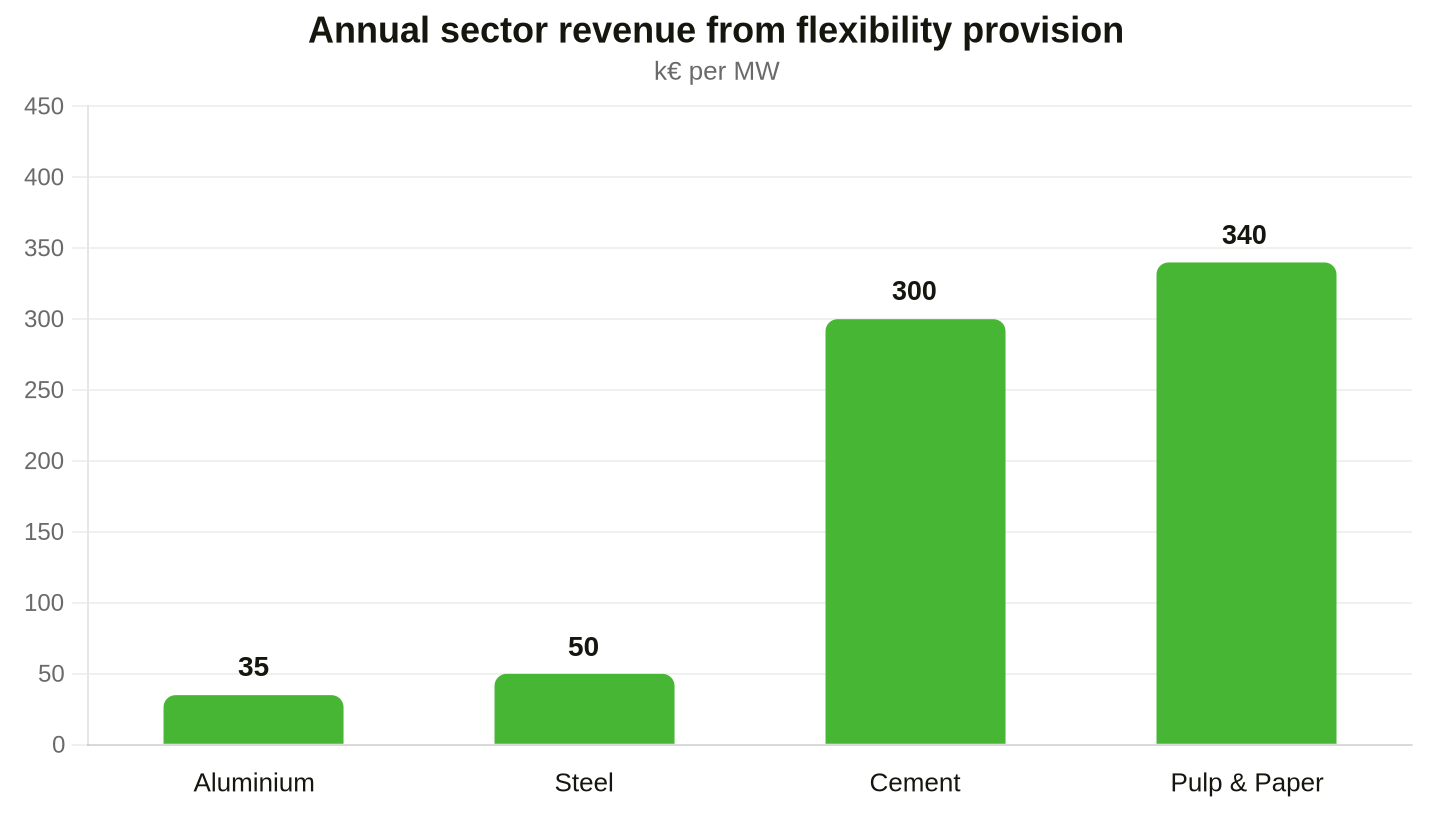
The gap between sectors is striking. Pulp and paper plants earn around €340,000 per megawatt annually from flexibility services — nearly ten times the €35,000 per megawatt recorded in aluminium — because they can store steam and activate demand response up to 1,400 times a year. Steel electric arc furnaces can shed up to 80 per cent of load in batch mode, while aluminium electrolysis allows reductions of up to 88 per cent, though the opportunity cost runs to roughly €550 per megawatt-hour. Cement grinding offers flexibility of up to 75 per cent with more than 900 annual activations, closing up to 85 per cent of the cost gap on decarbonisation measures.
The aggregate potential is large. Industry accounts for about 35 per cent of EU electricity consumption and more than 40 per cent in Germany. The authors calculate that demand management could cut renewable curtailment by at least 15.5 TWh — a 61 per cent reduction — by 2030 and avoid the construction of at least 60 GW of peaking capacity. System-wide savings are put at over €300 billion a year, with consumer savings from flexible assets exceeding €71 billion and annual reductions in grid costs reaching up to €29 billion.
Three case studies illustrate the range: Sappi’s 20 MW electric boiler in Maastricht (€6.5 million investment, five-minute fuel switching); Peter Bade’s AI-managed cold-logistics site in Neumünster, which cut grid fees 44 per cent in 2025 while saving 54 tonnes of CO₂ annually; and Speira’s 1.6 MW battery in Hamburg, generating over €100,000 a year through peak shaving and balancing-market participation.
The report calls for equal market access for demand response, flexibility-oriented grid tariffs and compatible digital interfaces. It also flags that EU electricity is taxed on average 1.4 times more heavily than gas — a distortion the authors say should be corrected. Demand response alone, they note, cannot meet future flexibility needs; large-scale storage and bidirectional EV charging remain indispensable complements.
Source: pv Europe
Become a member of 100 RE UA
Switching to 100% renewable energy in Ukraine is possible!