Sodium-Ion Batteries Could Undercut LFP on Lifetime Costs Despite Higher Entry Price
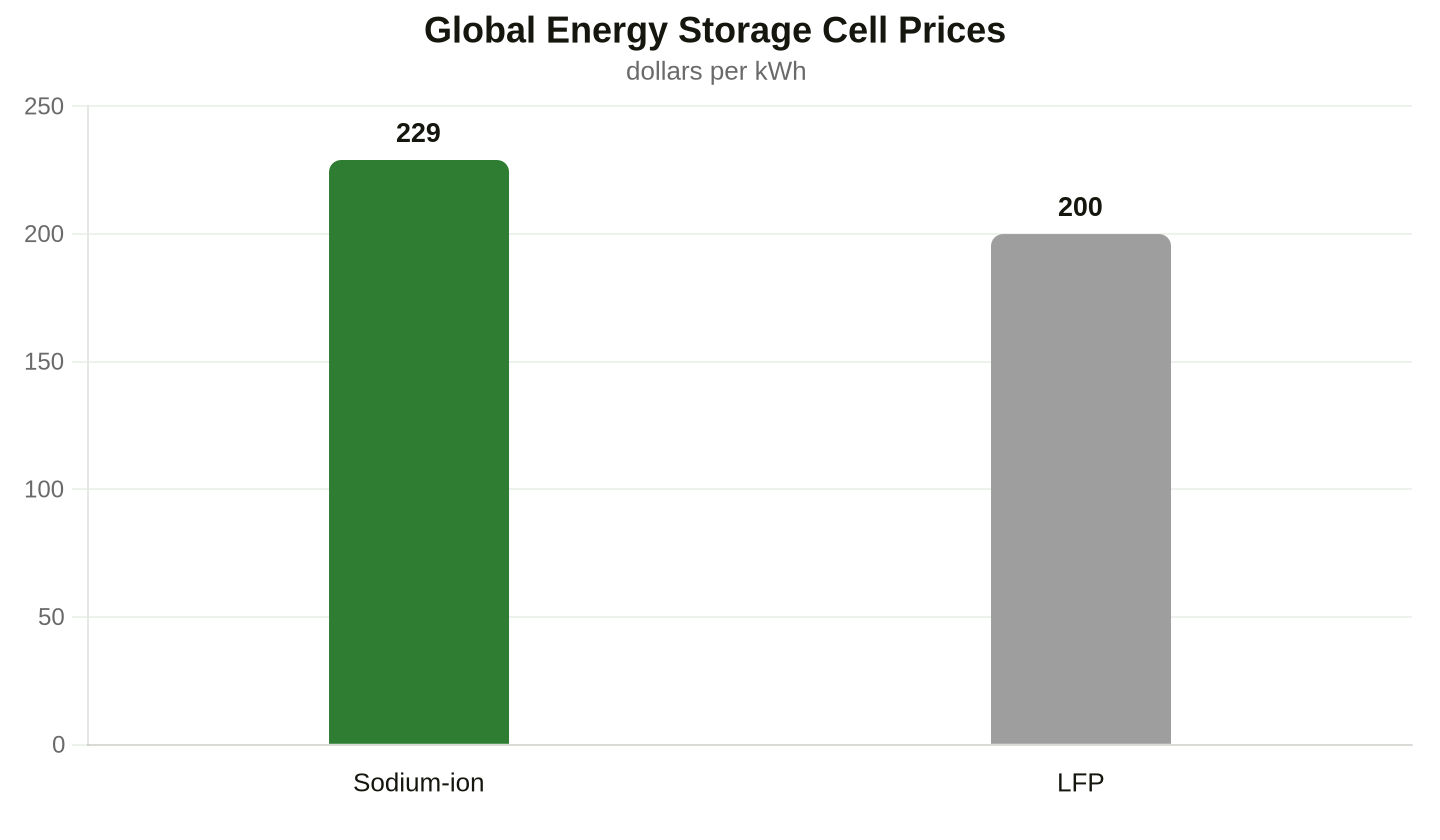
Sodium-ion batteries carry a steeper upfront price tag than their lithium iron phosphate rivals — roughly $229 per kilowatt-hour against around $200 for LFP — yet new analysis from Wood Mackenzie suggests the gap reverses decisively over a 20-year project life. Lifecycle ownership costs for sodium chemistry could run about 21% beneath those of LFP, driven by avoiding capacity-augmentation cycles, cold-weather resilience without active heating, and a longer service life.
Wood Mackenzie identifies sodium as the most promising lithium alternative for stationary storage. Cell-level cost parity with LFP is forecast for leading manufacturers by late 2026, though equivalent economics at the module and integrated-system levels will likely take until after 2030. The technology performs reliably in two-to-four-hour discharge windows.
Commercial momentum is already building. Signed supply contracts globally surpass 70 GWh across China, the United States, and Europe. BYD is targeting 30 GWh of annual production capacity in China, while CATL plans to ship more than 1 GWh before the end of 2026. Wood Mackenzie projects an 18–20% learning rate for the Chinese supply chain over 2026–2035, pointing to continued steep cost declines.
Policy is reshaping competitive dynamics on multiple fronts:
- China has reinstated an excise levy on lithium-ion batteries — 2% on LFP from September 2026, rising to 4% in 2027 — while exempting sodium through 2028.
- US tariffs of roughly 58% on Chinese-made cells persist alongside Section 45X manufacturing credits under the Inflation Reduction Act.
- The EU now mandates carbon-footprint declarations under its Battery Regulation.
- India has introduced $1.25 billion in production incentives and partial duty waivers on manufacturing equipment.
For projects advancing today, LFP remains the more commercially mature choice. Wood Mackenzie identifies 2030–2035 as the pivotal window for sodium-ion technology to reach widespread adoption.
Source: ESS News (pv magazine)
Become a member of 100 RE UA
Switching to 100% renewable energy in Ukraine is possible!